Choosing sellers and finds from the Mulebuy Spreadsheet before you pay
Most bad orders were visible on the listing before anyone paid. These are the things to read on the seller's page and in the option menu, with our catalogue counts from 20 October 2026.
Reading the seller behind a card
Choosing a seller on Weidian means reading a small shop, not a marketplace profile. Open the shop from the listing and look at three things: whether its other listings use the same photo style, whether size charts are its own or pasted from elsewhere, and whether option names are written with care or as bare numbers.
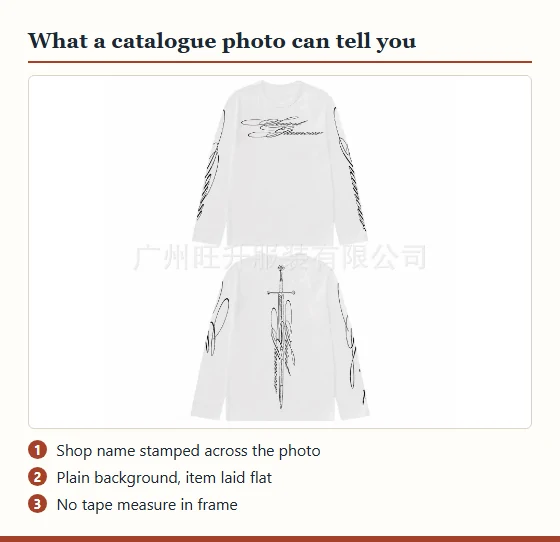
A watermark on a photo tells you whose photo it is, not who made the item. Shop names stamped across product photos turn up on catalogue finds. They show where the photo came from, which is useful when the same picture appears under several shops.
Careful sellers tend to show the item flat on a plain surface, with one photo where a tape measure is visible. That is also exactly what you are asking the warehouse to repeat.
Size charts are the seller's measurements, taken their way
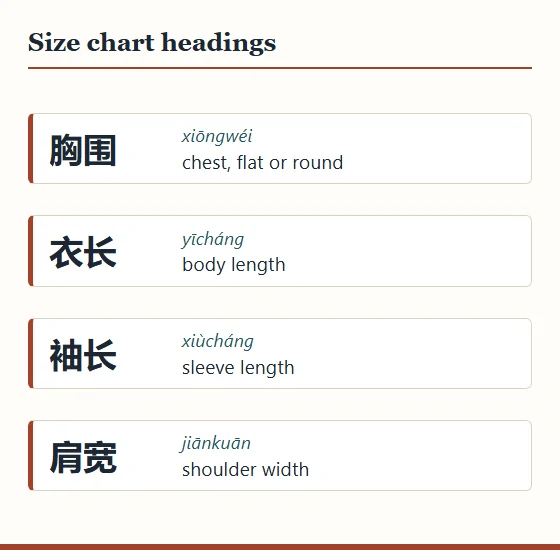
A seller's chart is a set of measurements made by one person in one way. Many give the chest as a flat width, some as the full round, and a few list body sizes rather than garment sizes. If the column headings are in Chinese, 胸围 is chest, 衣长 is length, 袖长 is sleeve and 肩宽 is shoulder width.
When a chart's numbers look odd, say a chest of 120 on a T-shirt that fits a medium, it is probably the full round. Halve it and compare with your own flat measurement.
Put the doubt into the remark. "Is the chest on your chart flat or all the way round" is a fair before-purchase question, and the answer settles which size to buy.
How much a listing lets you check
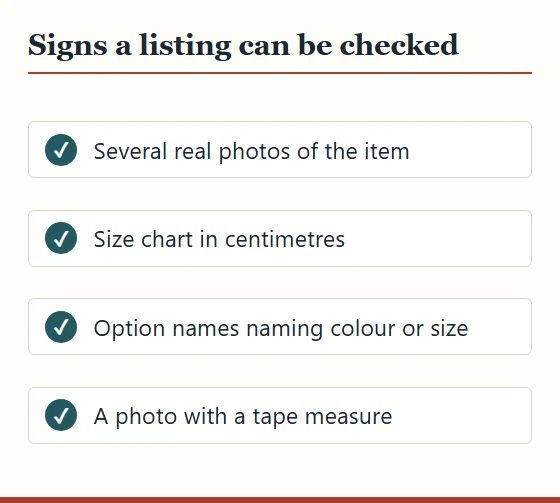
Choosing an item comes down to how much the listing lets you check before you pay. Prefer listings with several real photos of the item over one polished render, a size chart in centimetres, and option names that describe the actual colour or size.
Title words are less useful than they look. Catalogue titles are cleaned-up English versions of the seller's Chinese, so adjectives such as heavyweight or premium may be a translation of the seller's sales copy rather than a description. The photos and the chart carry more weight.
If two listings show the same photo, read both menus. The cheaper one may differ in fabric weight, sizing or what is included.
Price ranges and the option you actually pay for
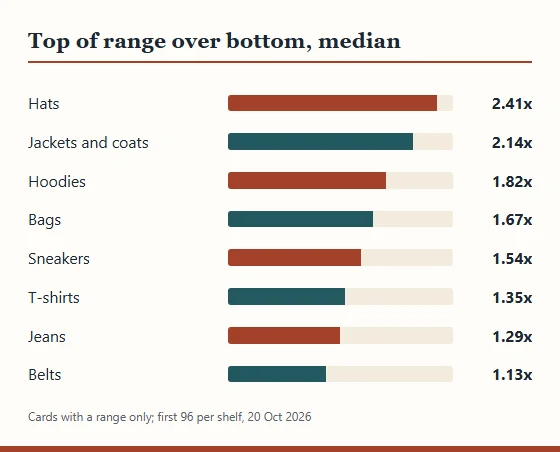
In our 20 October 2026 pull, between a quarter and a half of the cards on each shelf carried a price range. Where they did, the top of the range was a fair way above the bottom: the median top-to-bottom ratio was 2.41 for hats, 2.14 for jackets and coats, 1.82 for hoodies and 1.67 for bags, but only 1.13 for belts.
A wide range usually means the menu mixes different things under one listing, such as a single item and a bundle, or two materials. Read every option before choosing, and copy the chosen one into the remark so the buyer does not substitute the lowest-priced one.
Checks before money leaves your account
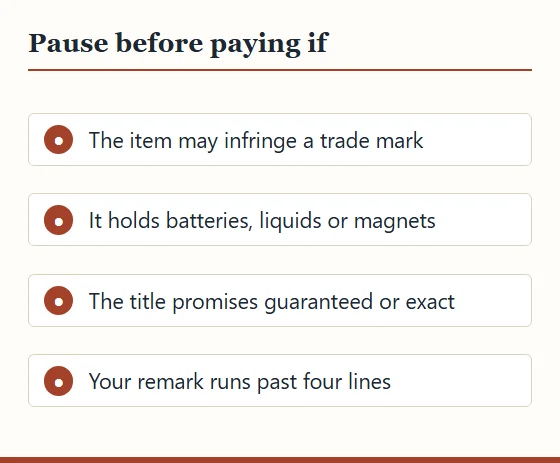
Some listings cannot be bought at all. Agents refuse goods that infringe trade marks, and they restrict batteries, liquids, powders and magnets to certain lines or refuse them. Read the anti-counterfeiting rules of the agent you use before ordering anything branded. Check before you build a parcel around an item.
Be wary of words such as guaranteed or exact in a title or a seller message. The listing cannot promise more than the warehouse can photograph.
Last, keep your remarks short. A buyer working through many orders acts on the first clear line and may skim the rest.
Mistakes that start in the remark
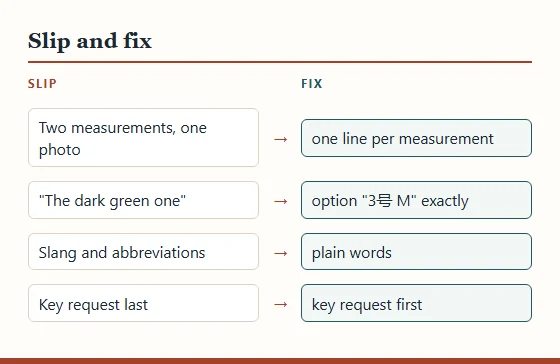
The same few slips turn up again and again. Asking for two measurements in one photo, so the tape can only show one. Describing a colour in English when the menu lists it as 3号. Using slang the buyer will not recognise. Putting the important request last.
Each has a simple fix: one request per line, the option string copied exactly, plain words, and the request that would make you cancel at the top.