
The warehouse report on a Mulebuy Spreadsheet order, read line by line
Use the received-item record, not a catalogue photo. Historical policy examples below need confirmation against the current terms of the order.
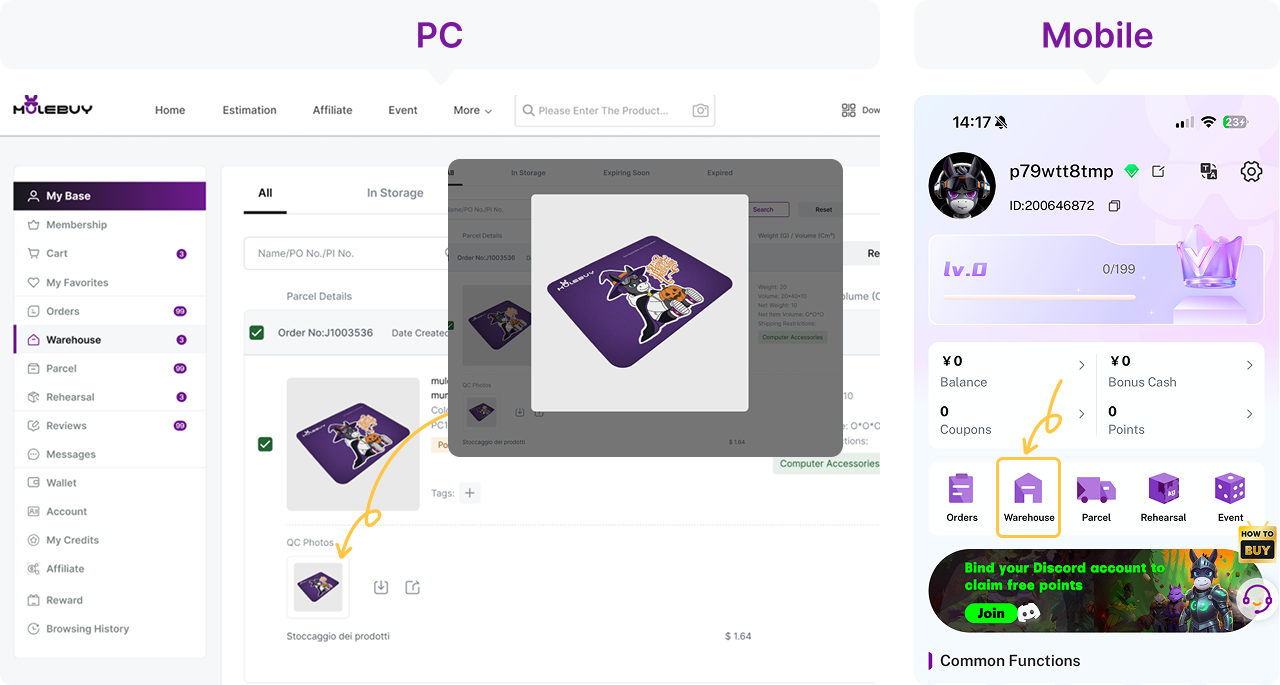
The warehouse report is evidence to compare with your paid option and remark. It can be updated with extra photos or messages. Keep the stored date and the applicable return deadline separate from the date you first read the report.
What the QC photos usually contain
Standard QC photos show the item from a few fixed angles under warehouse lighting: front, back, a side or the label, sometimes a detail. The number varies by agent. Going by their own pages, read between 10 and 16 October 2026, LoongBuy said eligible items normally received 3 to 7 standard photos, ACBuy described 3 basic photos per item, and LitBuy said routine photos were generally 3 to 6.
The weight comes with the photos or soon after. It is the item's weight in its own packaging, not the parcel weight you will pay shipping on, which is set later when items are packed together.
Check whether each requested service was accepted and whether its answer appears in a photo or message. A remark alone does not guarantee an extra service. If an agreed measurement is missing, quote the request and ask for the specific missing evidence before the applicable deadline.
How to check QC photos against your remark
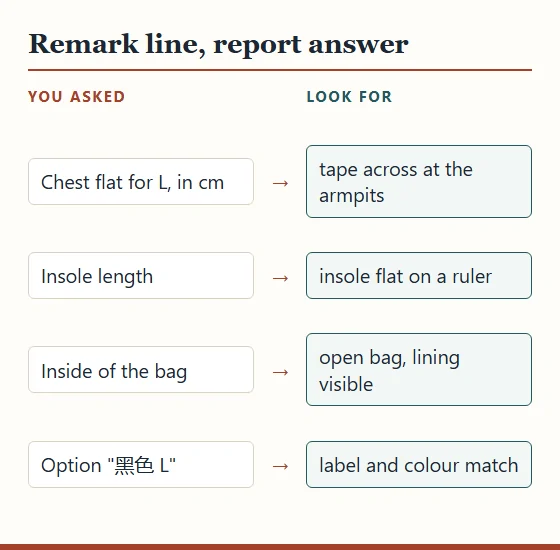
Open the remark and the report side by side and go line by line. For each line, find the photo or message that answers it, then decide: answered, answered badly, or missing. Write the result down; you may need to quote it.
"Answered badly" is the common case. The tape is across the hem instead of the chest, the insole sits on a patterned surface so the ruler is hard to read, or the strap is photographed coiled. Those are worth one polite follow-up quoting your original line.
Only then look at the rest of the photos for faults. Starting with your own questions keeps you from being distracted by a nice photo of the front.
Size: read the tape, not the label
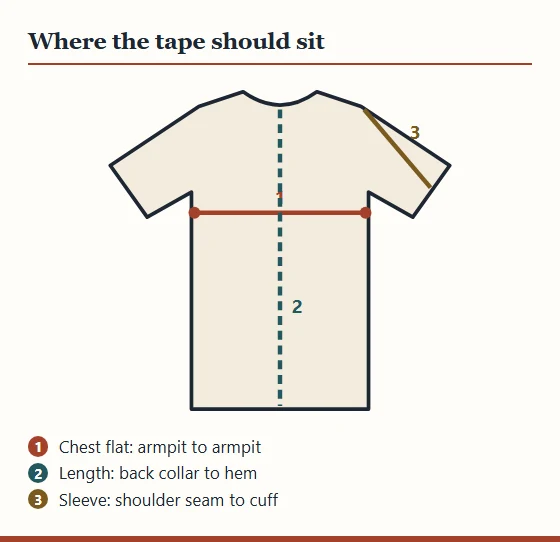
A size label tells you what the factory called it. The tape tells you what you are getting. Zoom in on the photo until you can read the figure at the edge of the garment, and check where the tape starts: a tape laid from the side seam rather than the armpit adds a centimetre or two.
Compare the number with a garment you already own, measured the same way on a flat table. That comparison is worth more than any size chart, the seller's included.
Confirm that the tape uses the same start and end points as the seller’s chart, and check any stated tolerance for that item. There is no universal one-centimetre allowance. A difference can reflect technique, the chart, the cut or the selected size; ask for a clear measurement before deciding which explanation fits.
Colour and option against the menu photo
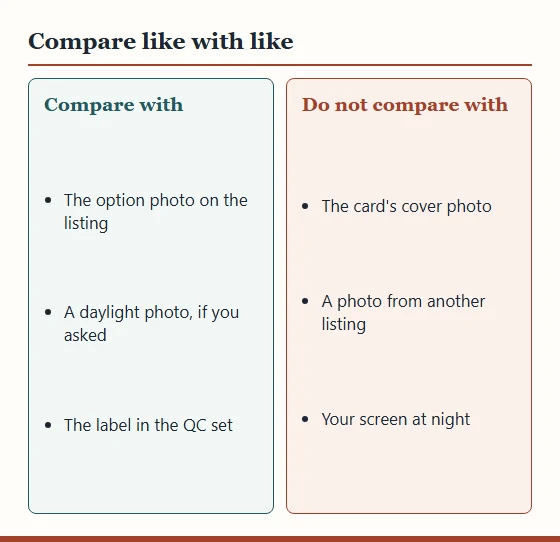
Warehouse lighting is bright and cool, and phone cameras shift colours. Compare the QC photo with the option photo on the listing, not with the card's cover photo, which may show a different colour entirely.
LoongBuy's inspection page, updated in September 2026, set a useful rule of thumb: where the seller's listing is missing, blurred or unusable for comparison, the actual QC photos become the primary reference and the warehouse will not infer details it cannot verify. A clear option photo is what gives a colour complaint something to stand on.
If colour decides whether you keep the item, ask in the remark for one photo in daylight beside a white sheet of paper.
Damage, stains and missing parts
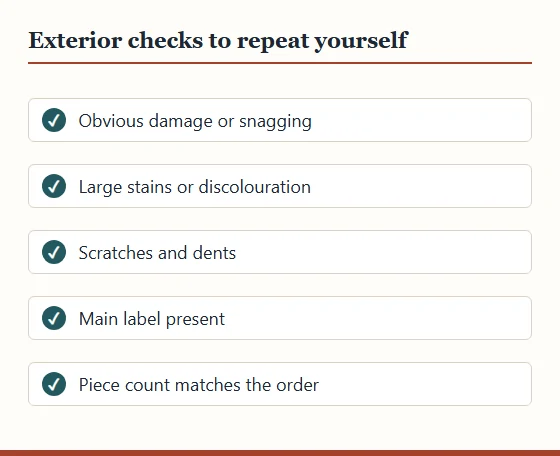
Standard inspection covers what can be seen without using the item. LoongBuy's September 2026 page listed obvious damage, large stains or discolouration, scratches, snagging, dents and missing main labels among the exterior checks. ACBuy's pages, read in October 2026, said electronics were checked for appearance only and never powered on.
Look at the corners of each photo as well as the centre: loose threads at a cuff, a scuff on a sole edge, a missing strap in the bag photo. Check that the count is right if the order was for more than one piece; a multi-item order may share one set of photos rather than getting a set per piece.
When the report says no: returns inside the window
If the item is wrong, act inside the window. ACBuy, OrientDig and LitBuy all allowed 120 hours from the order being marked as stored, according to their return pages read in October 2026. LoongBuy's help centre described a 5-day no-reason return for some eligible products, leaving scope and time limits to platform and seller rules.
The dated comparison pages allocated charges differently for customer-reason and seller-fault returns, with specific service fees. Use that distinction as a question to ask, not a guaranteed refund: confirm return eligibility, seller acceptance, postage and handling costs in writing before sending the item back.
Quote your remark in the return request. "I asked for chest flat over 58 cm; the photo shows 54 cm" is a stronger case than "too small".
Asking for more photos after the report
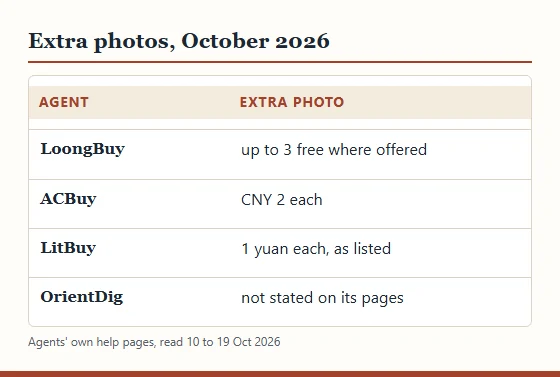
If the standard set does not answer your remark, you can usually buy more. Prices differed when we read the pages: ACBuy charged CNY 2 per detailed photo, LitBuy listed custom photos at 1 yuan each, and LoongBuy's inspection page said that, on order pages offering it, as many as three extra photos could cost nothing, with the page itself showing the exact allowance.
One extra photo that answers a precise request beats three vague ones. Name the part, the angle and what should be in frame: "the left cuff from the inside, with a ruler".
A mixed denim image needs an exact option in the remark
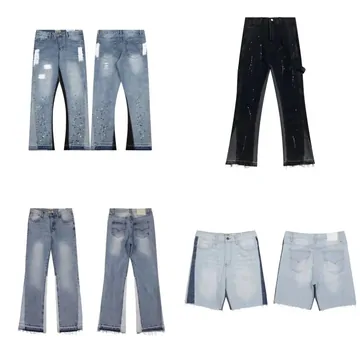
Long jeans and shorts share this image. “The blue pair” is therefore an ambiguous request. Include the exact option text or number, wash, length and selected size before asking for a measurement.
The collage has no tape and does not show a readable size label. The remark should ask for flat waist and inseam on the actual received pair, if the standard report does not show them. Those measurements must use the seller’s stated method; do not compare a body waist circumference directly with a flat garment width.
When the report arrives, quote the observed result rather than writing “bad quality.” For example, explain that the received option is shorts while the saved selection is full-length jeans, and attach both pieces of evidence. A precise mismatch gives the buyer something concrete to take back to the seller.